




From Design to Disaster: How Poor Engineering Documentation Leads to Operational Failure
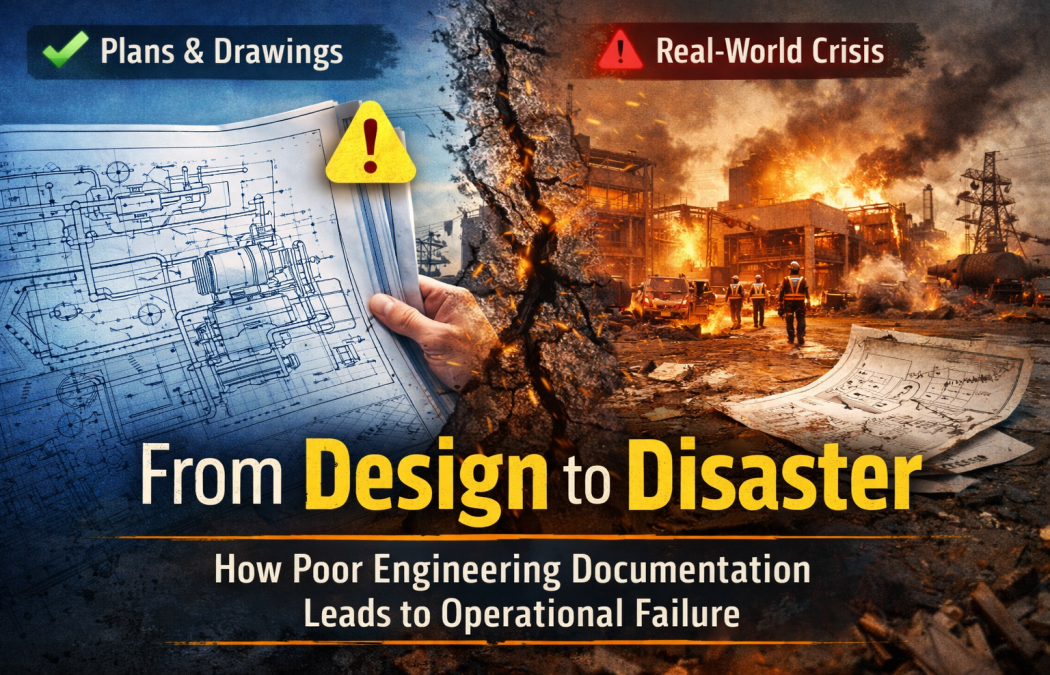
Most industrial disasters don’t start with explosions or alarms.
They start with missing pages, unclear drawings, and assumptions nobody wrote down.
By the time the failure is visible on site, the real damage has already been done — quietly, on paper.
The Illusion That Documentation Is “Just Paper”
In many projects, documentation is treated as a formality.
Something to:
- Satisfy procurement
- Tick regulatory boxes
- File away after commissioning
Once the plant is running, attention shifts to operations.
The documents? Forgotten.
That is the first mistake.
Because when people leave, systems change, or problems appear — documents are all that remain.
Where Documentation Failure Really Begins
It rarely begins with laziness.
It begins with pressure.
- Deadlines are tight
- Budgets are stretched
- Projects are rushed to commissioning
So documentation becomes:
- Incomplete
- Copied from previous jobs
- Updated “later”
Later rarely comes.
The First Crack: Design Intent Is Not Recorded
Every system has a logic.
Why this pump size?
Why this pressure setpoint?
Why this material selection?
When design intent is not clearly documented:
- Operators don’t know safe limits
- Maintenance teams don’t know what is critical
- Engineers don’t know what must not be changed
So people improvise.
Improvisation is not a failure.
Improvisation without understanding is.
Drawings That Look Right — But Lie
Many drawings are technically “correct.”
They are also dangerously misleading.
- As-built drawings that were never updated
- Schematics that ignore field modifications
- Instrument tags that don’t match reality
Operators trust them.
Maintenance teams follow them.
And slowly, errors multiply.
No alarms.
No warnings.
Just silent drift toward failure.
When Procedures Become Guesswork
Operating procedures copied from OEM manuals assume ideal conditions.
But sites evolve:
- Raw materials change
- Loads increase
- Equipment is replaced
When procedures are not revised:
- Operators work from memory
- Safety steps are skipped
- Shortcuts become normal
That’s when systems stop being controlled — and start being managed by habit.
The Dangerous Gap Between Design and Operations
This is where most plants live.
Designers have left.
Contractors have moved on.
Operators inherited a system they did not build.
Without clear documentation:
- Small faults go unnoticed
- Early warning signs are missed
- Root causes are guessed, not identified
The plant keeps running — but in the wrong direction.
Why Documentation Failures Surface During Crisis
Documentation weaknesses stay hidden — until stress appears.
A power failure.
A process upset.
A sudden shutdown.
In those moments:
- Nobody knows which valve is critical
- Nobody knows which sequence matters
- Nobody knows what not to touch
Chaos follows.
Not because the system is complex —
but because knowledge was never preserved.
The Myth of “Experienced Operators Will Figure It Out”
Experience is valuable.
But experience without documentation is fragile.
When key people are absent:
- Decisions slow down
- Mistakes increase
- Risk multiplies
Plants don’t fail when people leave.
They fail when knowledge leaves with them.
What Good Documentation Actually Does
Good documentation does not make systems complicated.
It makes them survivable.
It:
- Captures design logic
- Defines safe boundaries
- Guides troubleshooting
- Shortens downtime
- Reduces dependency on individuals
It turns chaos into process.
Designing Documents for Reality
Documentation must assume:
- Staff turnover
- Delayed maintenance
- Emergency conditions
- Human error
If documents only work when everything is calm,
they will fail when things matter most.
The Quiet Truth No One Likes to Admit
Many operational failures blamed on:
- Operators
- Maintenance
- “African conditions”
Are actually documentation failures.
The system behaved exactly as allowed —
just not as intended.
Disasters Don’t Begin on Site
They begin when:
- Design intent is not written down
- Drawings are not updated
- Procedures are not realistic
The plant didn’t forget how it was designed.
We forgot to tell it.
In the next article:
We’ll expose the specific documents every industrial facility thinks it has — but usually doesn’t.
And once you see them missing, you won’t be able to unsee the risk.