




Pump Sizing: The Quiet Decision That Determines Everything
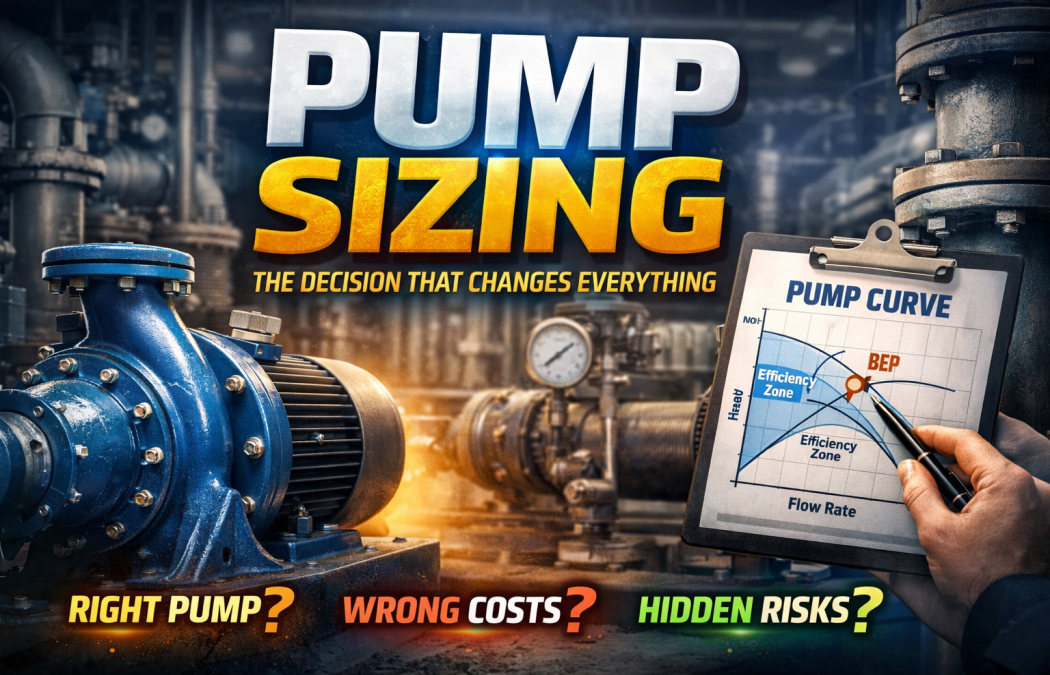
Pump sizing looks harmless on paper.
Just numbers. Flow rate. Head. Power.
Yet in real projects, pump sizing is the point where good systems quietly fail.
Not with noise.
Not with alarms.
But with rising energy bills, constant breakdowns, poor performance, and frustrated operators.
If you want a pump system that actually works in the real world — not just in a design report — this is where the conversation must start.
Let’s break it down.
What Pump Sizing Really Means (Beyond the Formula)
Pump sizing is not about choosing a pump.
It is about choosing the right pump for the exact job, environment, and future reality of the system.
In simple terms, pump sizing answers three questions:
- How much fluid must move?
- How far must it be moved?
- Under what real-life conditions?
Miss any of these, and the pump will struggle — even if it is brand new.
Why Most Pump Systems Are Poorly Sized
In many projects, pump sizing fails for predictable reasons:
- Designers rush calculations
- Safety factors are exaggerated
- Local operating conditions are ignored
- Future expansion is guessed, not planned
The result?
Pumps that are:
- Too big (wasting power)
- Too small (failing under load)
- Always running off their best efficiency point
And the system pays the price every single day.
The Three Numbers That Control Everything
Before brands, prices, or materials, pump sizing revolves around three critical parameters.
1. Flow Rate (Q)
Flow rate is how much fluid the system needs — not how much you wish it could move.
Key mistake:
Designing for peak demand that occurs once a month.
Better approach:
Design for real operating demand, then confirm how often peak conditions actually happen.
Oversized flow = wasted energy
Undersized flow = poor service
2. Total Dynamic Head (TDH)
This is where most errors hide.
TDH is not just vertical height.
It includes:
- Static lift
- Pipe friction losses
- Valves and fittings
- Changes over time (scaling, wear, fouling)
Ignoring friction losses is one of the fastest ways to undersize a pump — especially in long pipe networks.
3. Pump Efficiency
Efficiency is not a fixed number.
It changes with:
- Flow rate
- Head
- Speed
- Fluid condition
The goal is simple:
Operate the pump as close as possible to its Best Efficiency Point (BEP).
Anything far from BEP means:
- More vibration
- Faster wear
- Higher energy consumption
The Hidden Cost of Oversizing
Many engineers oversize pumps “just to be safe.”
It feels responsible.
It is usually expensive.
Oversized pumps:
- Consume more electricity
- Require throttling (wasting energy)
- Experience cavitation and seal failure
- Shorten system lifespan
In industries where power is already unreliable and expensive, oversizing quietly drains profit.
The African Reality Designers Must Respect
Pump sizing in Africa is not the same as pump sizing on paper.
Real conditions include:
- Unstable power supply
- Variable water quality
- Inconsistent maintenance
- High ambient temperatures
- Long supply chains for spare parts
A perfectly sized pump that cannot tolerate voltage fluctuation or dirty water is still a bad choice.
Good sizing considers context, not just calculations.
Pump Curves: The Graph Everyone Skips (and Regrets)
Pump curves are not optional reading.
They show:
- Flow vs head
- Efficiency range
- Power requirement
- NPSH limits
The correct pump is not the one that meets the duty point —
It is the one that meets it comfortably within the efficient zone.
Ignore the curve, and the system will teach you the lesson later.
One Pump, Many Futures
Smart pump sizing also looks forward.
Ask:
- Will demand increase?
- Will pipe length change?
- Will operating hours rise?
Instead of oversizing blindly, modern systems use:
- Variable speed drives (VSDs)
- Modular pump arrangements
- Parallel pump setups
This keeps efficiency high today — and flexibility intact tomorrow.
The Question You Should Always Ask
Before approving any pump, ask this:
“Where will this pump operate most of its life?”
Not at startup.
Not at peak demand.
But on an average working day.
That answer reveals whether the sizing is thoughtful — or careless.
Pump Sizing Is a Business Decision
Pump sizing is not just mechanical.
It affects:
- Energy bills
- Downtime
- Maintenance budgets
- System reliability
- Customer satisfaction
Get it right, and the pump disappears into the background — quietly doing its job.
Get it wrong, and it becomes the loudest problem in the room.
And this is why pump sizing deserves far more attention than it usually gets.