




The Truth About “Low-Cost” Engineering Solutions in Developing Markets
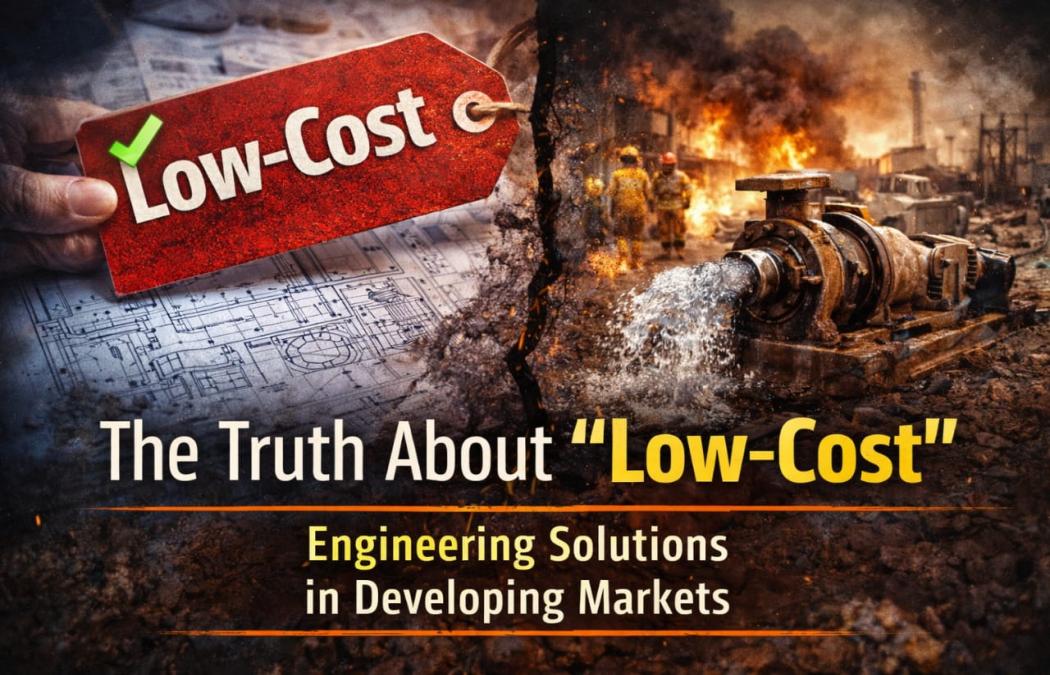
Everyone wants low cost.
Procurement demands it.
Budgets reward it.
Proposals compete on it.
But in developing markets, “low-cost” engineering is often the most expensive decision a project will ever make.
The damage doesn’t show on the invoice.
It shows months later — in downtime, repairs, lost trust, and systems that never quite work.
Why “Low-Cost” Sounds Like Smart Engineering
On paper, it makes sense.
- Capital is limited
- Projects must move fast
- ROI is under pressure
So cheaper options feel responsible.
Practical.
Efficient.
Until the system is switched on.
What Low-Cost Really Means (But No One Says)
Low-cost rarely means optimized.
It usually means something was removed.
- Lower material grade
- Thinner walls
- Fewer redundancies
- Simplified controls
- Minimal documentation
Each cut looks small.
Together, they change the system’s behavior.
The First Phase: It Works (Barely)
Low-cost systems almost always pass commissioning.
Pumps run.
Flows meet targets.
Outputs look acceptable.
This is the most dangerous stage.
Because everyone relaxes — just as stress begins to build.
The Second Phase: Hidden Costs Start Accumulating
After a few months, subtle changes appear:
- Energy consumption rises
- Operators intervene more often
- Spare parts are replaced earlier than expected
- Maintenance becomes reactive
Nothing has “failed.”
But everything is working harder than it should.
Low-cost systems don’t break early.
They age early.
Why Developing Markets Suffer More
Low-cost engineering fails faster here because conditions are harsher.
- Power is unstable
- Inputs vary widely
- Maintenance is delayed
- Systems are pushed beyond design limits
A design that survives on the edge in ideal conditions collapses under stress.
Low-cost removes the safety margins that reality demands.
The Maintenance Trap
Once the system starts demanding attention:
- Maintenance budgets increase
- Downtime becomes normal
- Emergency procurement replaces planning
Ironically, the project becomes more expensive to operate than a properly designed alternative.
At this stage, management says:
“Engineering is expensive.”
No.
- Cheap engineering is expensive.
The False Economy of Replacement
When low-cost systems underperform, the response is often:
- Replace components
- Upgrade sections
- Patch weaknesses
But these fixes:
- Rarely integrate well
- Introduce new failure points
- Increase complexity
The system becomes a collection of compromises.
What Real Cost-Effective Engineering Looks Like
True cost-effective engineering is not cheap.
It is balanced.
It invests in:
- Critical materials
- Proper sizing
- Simple, robust design
- Local serviceability
- Clear documentation
It costs more upfront.
It costs far less over time.
The Question Engineers Should Ask First
Not:
“How cheap can we build this?”
But:
“What will this system cost to live with?”
If the answer is unclear, the project is already in trouble.
The Human Cost Nobody Calculates
Low-cost systems:
- Frustrate operators
- Burn out maintenance teams
- Create blame culture
- Damage professional credibility
People stop trusting the system — and eventually, each other.
Cheap Is a Strategy, Not a Value
Low-cost engineering is not a technical choice.
It is a philosophy.
And in developing markets, it often says:
“We expect failure — we’re just trying to delay it.”
The best projects don’t aim to be cheap.
They aim to be forgiving, durable, and predictable.
Because in the long run,
the most affordable system is the one that keeps working.